Motivations
I have had the time and space to reflect recently. You can become so laser focused on a thing that it makes reflection impossible, and I think that has been the case with Defiant for the last year. With my ship out of commission and our re-launch pending, I lacked that immediate next thing that had to be tackled; everything broken was, for the moment, in the hands of vendors (and consequently out of mine). From the mundane luxury of a Philadelphia Airbnb I found myself asking a question:
“What in the fuck am I doing?”
~ me
Tim Labute once said that everything in life is 10% harder on a boat (I’d argue 20-50% is more accurate if you’re doing a refit). Temporarily returning to a world with endless water, unlimited power and 24 hour Uber Eats, especially after the last year’s tribulations, would give pause to most people about going back out there. I got to thinking about my reasoning when this whole debacle began, a little over two years ago. I tried to remember what I believed I would accomplish back then, and be honest with myself about how accurate my predictions had turned out. I thought about the things I hadn’t accounted for, the changes in the world and in myself. The more I thought, the more I decided I should write those thoughts here. Mostly as catharsis, or some kind of personal long-term accountability reference, but maybe also to help frame everything else I share along the way.
I’ll break these reasons down systematically, because that’s how my brain likes things.
✅ Finances
What I Believed
I have spent most of my adult life snared in the HENRY trap. Though most reading on the subject focuses on lifestyle inflation, the other side of the coin is created by upward mobility, aka the Gatsby curve. Like most HENRYs I invested in one strategy after another to try and break the cycle - real estate, then higher education, finally startup sweat equity - grinding away nights and weekends. But it was impossible as long as I continued to color within the lines. Once remote work became more common I had my first real option; I would have to continue working those long hours at high-stress urban tech jobs, but physically move myself to some tiny town in Nebraska as an 80% cost of living reduction. I would need to live there under an extreme austerity budget while I paid off my student loans, built a proper liquid safety net, and backfilled the foundational wealth missing from my 20s. After about a decade out in the corn fields, I would finally be able to move back into the city with my peers - and at that point I might even be able to retire before I turned 136. Funny, those hope-filled master’s degree commercials seem to have left this part of the equation out.
A sailboat was cheaper than rural Nebraska, and it wasn’t rural or Nebraska. In fact, a sailboat could technically be anywhere there was water. NYC, Miami, Philly, San Juan - I could live everywhere. My early math had me financially upright and out of the HENRY trap in a year, even after I traded in full-time W2 startup work for a 20 hour a week gig as a 1099 consultant. Work half as much, live in all the great places and finally be on the road to financial sovereignty.
The Reality
I was more right than wrong. I did only work 20ish hours a week for most of the first year, and immediately had a better cash flow position than ever before. Boat expenses far exceeded my expectations, and I needed to tap out more often than expected and get a place to stay on land. Slip fees, even in Philadelphia, pile up fast, and around the big northeast cities anchoring long-term is not a realistic option.
Even after discovering my first boat was structurally unsound and eating the more than $30k I sank into her, then spending another $45k on Defiant and at least double that in the refit, this endeavor has been a financial success. I did go back to a full-time W2 startup role, but that was mostly because I was too mentally and emotionally involved with the company to keep it casual (I believe in the business, and I wanted an equity stake). Rent is some of the savings, but in truth, the majority of cost reduction is the lifestyle that staying aboard imposes on you. Defiant needs tremendous work - many more hours than I have to give her. I don’t go out to dinner and drinks five nights a week, I am instead in the bilge replacing faulty wiring or hanging off the transom patching fiberglass, right until it is time to shower and pass out. Boat parts generally don’t cost much (when compared to land house parts). Sweat equity value is very high, and that means you are getting a whole lot done every weekend without swiping away at your credit card. Those expenses do seem to be tapering, too, and the more big expensive things you fix/replace, the fewer big/expensive things there are left that can possibly need fixing/replacing.
So, am I independently wealthy yet, two years in? No. Am I well on my way, with a timeline that is both realistic and no longer depressing? Yes. Overall, living aboard is an absolute financial win.
✅ Hardship
“To dare is to lose one’s footing momentarily. Not to dare is to lose oneself.”
~ Soren Kierkegaard, An Eternity for Repenting
What I Believed
The first days of this recent land visit felt decadent. Normal people take normal showers every day without considering where the water comes from. They flush toilets without checking the treatment tank amperage, and think nothing of leaving a phone charger plugged in between uses. The most banal urban existence brims with luxury when compared to life aboard. But by day four monotony had set in, and I remembered. The copy-of-a-copy feeling, every day effectively the same dull-edged routine. The same walks to the same coffee shops, the same morning runs. The same Milgram’s familiar strangers, the same view from your desk or the same other coffee shop, the same whiskey at the same barstools down the same streets, the same spot on the couch - and then it is tomorrow and now a copy-of-a-copy-of-a-copy.
The human condition demands that great satisfactions be earned, that our enjoyment is relational to whatever hardships and sufferings were required to obtain them. There is no mattress softer than the hard ground at the end of a 20 hour hike, no champagne as exquisite as a cheap beer after a day working in the desert sun. This past Saturday morning I sat outside a cafe in Fishtown while having my breakfast, one of at least 100 places to do so within a 20 minute walk, and I watched one couple after another stop to converse over the menu before moving on. In a world without hardship, the greatest question in life becomes “what will make today feel like it matters: the duck confit & fig breakfast tacos or the ras el hanout omelette?” The answer is neither, because the missing ingredient in both is a challenge. Row your dinghy through the freezing rain to a ship’s store for eggs, hoist a 20lb propane tank onboard to refuel the stove, shift a skillet over the fire with forearms still aching from the previous day’s “athletic” tacking, and you sit down to a more satisfying plate of scrambled eggs than anything ever prepared by the chefs of Le Cordon Bleu.
Sailing and living aboard were the red pill, stripping away the tranquilizers of ultra-convenient urban life and creating vast opportunities for hardship and subsequent accomplishment. Only when life is filled with challenges is it possible for life to be filled with wins.
The Reality
Again I was more right than wrong on this one, though not in exactly the way I had expected. Life aboard is a life of extreme highs and lows, often several of each in a single day. Compared to the near-comatose flatline of bohemian existence, it is as if a resistor has been removed from the sensor and the needle is allowed to swing wide across the page. This intensity is often exhausting, especially when there are several lows back-to-back between wins. But I cannot describe the self-satisfaction felt when I wash my hands after a dozen trips hauling jerry cans to refill our water tank, or warming my feet in front of the air vent after successfully repairing the diesel heater yet again. Yes, having your morning coffee alongside a pod of dolphins is cool - but the most prosaic of accomplishments are often the most rewarding. Arriving almost anywhere in the western world by conventional means is yawn-inspiring; you can cross 3,000 miles of the USA in complete comfort, never planning ahead for fuel or food or conditions. You don’t have to worry about interstate 80 being too dangerous to traverse for a week, or your flight from Tampa running out of fuel midway to NYC, or all the gas stations in Iowa being closed for a month; even in the driver’s seat you are a mostly passive passenger in the transportation process. On the water, everything can go wrong and often does, sometimes all at once. Pulling into a parking space at the Hilton Honors is a non-event, but tying off at your destination always signifies the end of an adventure.

⛔ Relationships
What I Believed
In my life I have been a husband, a boyfriend, and a domestic partner; I don’t know that I’ve ever been fantastic as any of those. When I was younger that upwardly mobile drive put my relationships second to my career ambitions, a wedge that would inevitably split them apart. Later, when the jaws of the HENRY trap snapped down on me, I allowed too much of that slow-rotting despair to infect every other part of my life, most of all my home life. Finances have always been a point of contention in my relationships (aren’t they in most?). Sailboat life was a complete financial shift, and with that shift came the potential for us to finally get things right.
The Reality
If the extremes of boat life are the red pill, most people will choose the milquetoast existence of the blue pill. This fact both dramatically limits the dating pool, and sours the odds of any existing relationship surviving the transition aboard. Boats provide far less “fluff” in which to bury difficult conversations; every person on a sailboat is either crew or passenger, and there is no room for ambiguity in that matter. And refits force this same clarity at a larger scale - one person cannot be going through the extreme highs and lows of the journey alone, while the other watches from the bleachers.

Over the last two years I vacillated in the same on-and-off relationship, a decision that I think ultimately did us both harm. Technology allows me to attend a board meeting from the deck of Defiant while anchored anywhere in the world. That same technology enabled a misguided relationship to limp along, across two completely incompatible worlds, postponing difficult, but necessary, decisions in a way that maximized hurt.
I learned that in the age of instant communication between any two points on Earth, the space between those who stay and those who go must be intentionally created. For thousands of years, ships left port and you were either on them or you were not. If you stayed, a vessel and all aboard her were gone from your life as soon as she crossed the horizon. But today that quantum string stays delicately attached, a trickle of adventure and excitement live streamed without any risk or hardship required. To the one who goes this is a terrible disservice - the risk, the struggle, the hardship and the reward watered down into play-by-play entertainment for those who make no sacrifice. Going forward, those who stay, stay, and those who go, go, and there is no confusing the two.
Does living on a sailboat make for an improved relationship? My hypothesis still stands - as of yet unproven, but also not yet disproven - that life aboard will lend itself well to life as part of a couple, and the hardship will hopefully help self-sort partners early on. Long-term I’d love to give this a “maybe,” but if I’m honestly looking at how my initial intentions turned out, this one’s a fail 😿.
✅ The State Of The World
What I Believed
Like a lot of people, I wasn’t overly fond of world trends in and around 2024. Politically and socially in particular, let’s say there was a lot to be desired. But there was another thing, a thing that had been growing. A sense that I no longer belonged - at least in Philly, but maybe in all of the USA, or maybe on Earth. Pedro Pascal was suddenly the correct archetype of masculinity. Everyone’s outside shoes were very soft. It felt as if a daddy longlegs spider could crawl across the table, and all of Philadelphia would collectively huddle in the corner while shrieking for someone to kill it - and then they would collectively resent me for squashing the spider and going about my day.

I didn’t know what to expect out in the world, but I had hope that my view of sanity still kept a foothold somewhere - or if not, I could wait out the crazy on my own floating sovereignty.
The Reality
There are a couple different things at play here, and my understanding today is drastically different from where I started two years ago. While boat shopping and living aboard I’ve traveled back and forth from the primarily progressive northeast to the more conservative mid-Atlantic/rural Virginia, down to northern Florida and Miami, and back up to New York.
I learned that I wasn’t imagining things, and that America has two very frightening, sealed-off media domes at the moment. Hint: if you believe there is just one bubble feeding people an extreme 1/3 slice of the facts, congrats! You are currently inside the other one 😉. Everyone I’ve met that is extensively traveling the country says the same thing right now - people in rural Georgia and people in Brooklyn are much more similar than they are different, and they would both be shocked to learn that the other is not the monster they’ve been sold to hate. Passing in and out of the progressive and conservative echo chambers over the last two years has afforded me an interesting view of each, and shown me the breadth of my blind spots. Now, I don’t tend to hang out with extremist crazies, so I can’t speak to those edges and you shouldn’t take my observations to include them. But my view of the world has been altered by my experiences, I believe for the better, living at once in both the rural south and the urban north.
⚠️Warning: This section is political, so I hid it behind a dropdown arrow (far left). You can skip it if you want. If you'd like to read it anyway, feel free to click the down arrow and continue. ⚠️
General observations from traveling the American East Coast:
Most Southern conservatives are more thoroughly informed, but more blindly ideologically committed. Which makes sense in a way - you don't need to hide facts from someone if you know they will rationalize away anything that doesn't fit their already cemented mental model. Fox News would absolutely report the full story on Donald Trump repeatedly kicking a sick dog, because they know the hardcore conservative base will say "well the dog probably deserved it." Fox may make unfounded implications that the dog had ties to Iran and hated only mail-persons of color, which the base will run with hard... but Fox will still run the story. When I share conflicting facts with southern conservatives, I've found they will usually assimilate those new facts into the narrative they already hold true - for example, if I bring up the terror and the personally close deaths in my life during the first month of the pandemic, those facts aren't denied as "fake news" (at least not with the people I've met); the new facts become assimilated, in this case as more evidence that lockdowns were ridiculous because "none of that was happening down here!" There have been a couple times where I genuinely felt unwelcome after something I said, but that has been the rare exception.
Most Northern progressives are less informed, and mistrust outside information more. This was hard for me to come to terms with, naturally - I have held traditionally liberal political values my whole life. Liberals were the guardians of free speech - when I was young conservatives burned books and silenced heretics, while liberals demanded everyone be allowed a voice. Then somewhere along the way, the blue bubble team calling themselves liberals became very comfortable with censorship. Facts and findings that disagree or even discount progressive ideology are labeled "hate speech" or "misinformation" and silenced inside the dome, and a strange sort of political xenophobia developed. Given the same example, MSNBC would simply not run a story about Kamala Harris repeatedly kicking a dog, at all, and if I was to then show a northern progressive the video of Kamala digging her high heel into Fido's back it would absolutely change their opinion... of me. I've found that many people that I was once very close with now behave like I am somehow "contaminated" by exposing myself to a world outside the blue bubble, which has been a sad side effect of my travels.
Why does this matter, and why write this in a sailing blog? Because sitting inside either bubble for any length of time will make a rational, logical person feel crazy, and that crazy feeling was a significant reason for my decision to move aboard. Both teams demand you ignore a nauseating level of cognitive dissonance to swallow what they are selling, but at least now I am aware of it. I no longer have that uneasy feeling when I am told that we are seated inside the land of virtue with a party wall keeping the evil "others" at bay; I realize these are two adjacent wings of the same insane asylum, and the only real difference is if the pudding cups are vegan.
A lot of what I was at odds with is completely universal. You can walk into a bar in Fayetteville or Brooklyn and find an equal number of people dressed like extras from Idiocracy. The waitress that finds your request for ketchup “triggering” might be in a Philly dive bar, or a Daytona beach hotdog stand. “Socially acceptable masculinity” is just as confused in the rural south as it is in the urban north - maybe more so, oscillating between Pedro Pascal and Andrew Tate.

It is a weird time to be alive, and living aboard has given me the buffer I needed from the more frightening zeitgeist. Some of the effects have been practical - my music and movie library is 26TB of 20th century content, so no ‘26 version of Masters of the Universe proclaims on my TV that “The most powerful weapon in the universe is empathy” 🤮. Most importantly, I feel unattached, ephemeral to any specific culture or lifestyle. If I am able to sail into NY Harbor in a month and find community there, great. Or I might find people that I relate to in a hidden anchorage off the coast of North Carolina, and that will be just fine. Still, maybe this ephemeral world is the world that makes sense to me. Maybe staying out on the edge and never getting bogged down in the mire is where I’ll belong.
✅ Star Trek
What I Believed
Everyone over the age of 14 has a part of them that wants to impress their 14-year-old self. Nobody wants to think preteen you would have thought 45 year old you is a loser. And 14 year old me loved Star Trek. And Star Trek was basically about life exploring on a ship in the space navy. And space navy and ship translate nicely to sailing vessel, plus we have all kinds of tech today that makes TNG life seem downright normal.
My day-to-day life could be, in a lot of ways, right off of the Enterprise.
The Reality
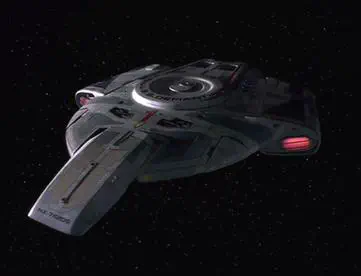
Pretty much nailed this one - though Defiant’s namesake is actually from Deep Space Nine, which I think is more apropos as the replicators (and everything else) are regularly failing when I need them. I use a touchscreen LCARS panel to monitor my power, water, fuel and computer systems. I set courses and navigate, worry about hull integrity after a hard wave strike, and alarms go off when an unknown vessel is approaching.
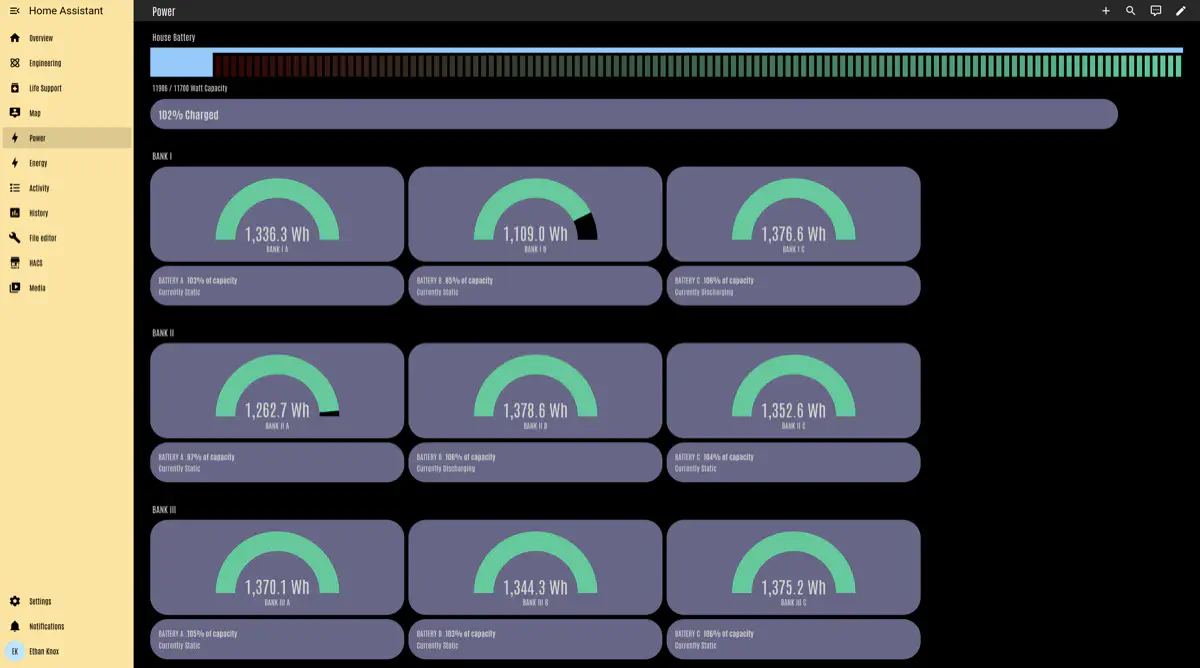
There are times that the whole experience feels a bit more run down - like something out of Star Wars, Ice Pirates or Firefly. I don’t think that would have bothered 14-year-old me too much.
⛔Health
What I Believed
Any time someone asks “how do you stay in shape when you live aboard?” the chorus replies “you live aboard!” The implication is that the physical hardships of sailing and living aboard a moving vessel, the “boat yoga” of endless maintenance work, the outdoor-focused lifestyle, the abundance of freshly caught fish and cooking aboard vs eating in restaurants will offset the lack of a gym, a running track and a readily available Whole Foods vegetable aisle. This is one of the few things the otherwise religiously contrarian sailing community seems to agree on. I just needed to live onboard, and I would be the most healthy I’ve ever been.
The Reality
Bullshit. This has proven to be complete nonsense, and it took me too long to abandon this view and course-correct towards reality. I am finally getting back towards a state of reasonable health, but I can say unequivocally that at one point while living aboard I found myself in the very worst physical condition of my life. Why?
Walkability. In Philly I walked everywhere, didn’t own a car, and rarely Ubered. Even in the monotony of walking the same ten blocks every day, I was walking those ten blocks. In most of the United States, walkability is a luxury and driving is the norm. The minute I find myself tethered to a dock with a parking lot and no way to leave by foot, all that free cardio vanishes instantly.
Food Storage. I have struggled with refrigeration issues since day one, and am still reliant on a powered cooler with slightly more capacity than a Transformers lunchbox (Thermos not included). This means even a head of cauliflower needs to be cooked as soon as I get it home and can’t be stored, making food prep almost impossible.
Quality Ingredient Deserts. Leaving bohemia for grocery stores in rural America, I was amazed how the offerings shifted from produce and products with simple ingredients to shelf-life first, heavily processed garbage. Finding a jar of peanut butter that is just peanuts is the search for the holy grail.
Time. In a refit, there is always something that needs to be done right now, and half of the time that thing explodes all over the galley counter in parts. If the boat is not in a state where cooking is an option, options become what I can eat now, fast, and get back to fixing things. Pausing work to go for a run or hit the gym is hard enough, but when that work has the shower disabled? Forget it.
Fast Food. If you live in Brooklyn and have any doubt that you are in fact one of the evil Capitol dwellers from the Hunger Games, drive down to any small town south of Washington D.C. and try getting something to eat. For huge swaths of the country, fast food is often the only option, ever. 24/7, your choice is either a Big Mac Meal or starving to death.
Adaptation. When I am learning a new thing, it can be hard to know where lines are drawn. For example, I traded in beer for liquor almost a decade ago - partially because of some weird allergy stuff, but mostly to avoid the beer gut. I learned from other sailors that after sailing in 100°F for 10 hours there is nothing that will cut through sun-burnt thirst like a frigidly cold light beer - not water, not Gatorade, not any cocktail on Earth. Once you’ve adjusted your views based on advice from someone who knows more than you on a subject, it is easy to lose track and suddenly find yourself eating 6000 calorie meals at midnight while pounding back brews - because it is what the expert is doing.
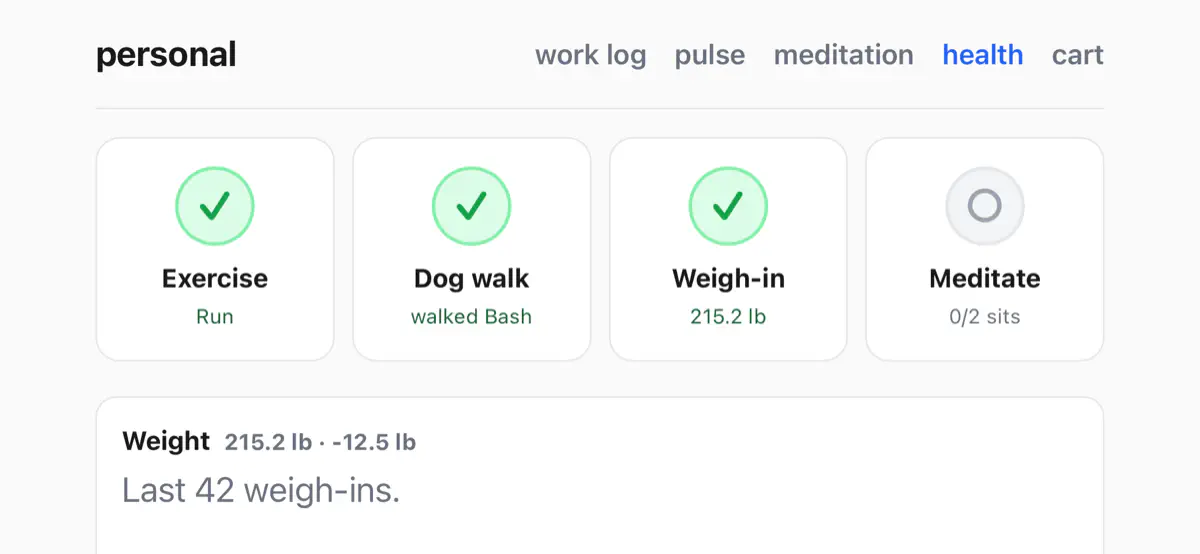
I realized I needed to more carefully manage my health onboard, and it became totally possible - it just required adaptation. I weigh in every morning to start the day. I run every day I have access to land (you can run pretty much anywhere that has ground), and I make a point to walk Bash for at least half an hour. When we are on the water (underway or at anchor) I have a yoga mat and a few different routines; guys get jacked in 10x10 prison cells, you don’t need a ton of space to stay in shape. I track everything in a little onboard app I spun up:
For food, the key in bad times is sustenance. There are a limited number of clean items that can combine to provide adequate nutrition and energy, and balance refrigeration requirements with shelf stability. It’s not a varied or exciting diet - lots of eggs, nuts, spinach, peanut butter, and celery - but it is functional. As refrigeration and storage becomes more reliable and abundant I’ll be able to expand (I’m greatly looking forward to it!). Eating out also just isn’t an option in some places, so I make sure to take advantage when reasonable choices (i.e. not a KFC Bucket) present themselves.
⛔ Travel
What I Believed
Traveling seems like one of the most obvious reasons to live on a sailboat. To qualify my interest first let me say that I despise “traveling” in the modern vacation/holiday sense. What most people call traveling is actually “pretending to be wealthy for a week somewhere other than where I usually live.” Ask someone who just came back from a Paris vacation what they loved, and they will most likely describe hanging out in cafes all day, going to museums, staying out late and indulging in fine restaurants - all of which is less about Paris and more about the person enjoying time off from work and spending disposable income. However living in different places - and I mean actually living, as in working, buying groceries, going to the laundromat, developing friendships and becoming meaningfully involved with the community - has been my default. I’ve had a driver’s license in New York, California, New Jersey, Pennsylvania, and next up Florida. I have lived many more places than that for months, sometimes years. With every relocation, the expense and the effort are massive - moving and storage, buying/selling property, paperwork, forwarding addresses etc. I have moved for opportunities, because my situation has changed, and also because the places where I lived have changed. A sailboat negates all the pain of relocating; there is a saying around most marinas, “if you don’t like your neighbors, I’ll help you untie your dock lines” - moving is as simple as casting off. My same home can winter in Bimini and summer in Kennebunkport, and I’d never have to pack a bag or get used to a different toilet seat.
The Reality
Traveling by sail requires a truly seaworthy vessel, both sound to sail and sound to live aboard full-time. Had I initially shelled out $150k on a fully refitted craft that was ready to cruise, or had I been a twenty-something with no worldly obligations, I would have been much more correct about this one. But neither of these were the case, and I have learned at great expenses financial, physical and mental, how “stuck” a sailboat can be.
The problem lies with cognitive dissonance across the different models of “boat life.” Each model is partially applicable, but together they are wholly incompatible. What are these models? There is the YouTube-famous influencer model, where young kids acquire a beat-up old sailboat and see the world while they fancy-camp on water. These descendants of Lin and Larry Pardey chant “go small, go simple, but go now!” as the universal answer. Then there is the floating condo owner model, whose members traverse the globe in 65ft catamarans, showering and changing polo shirts between lunch and dinner engagements. A third model that I think got lost in the mix but actually held the most relevance to my situation is the long-term refit sailor model, whose vessels are littered all over boat yards while their owners chip away via weekend projects for years, sometimes decades, planning on setting out “someday.”
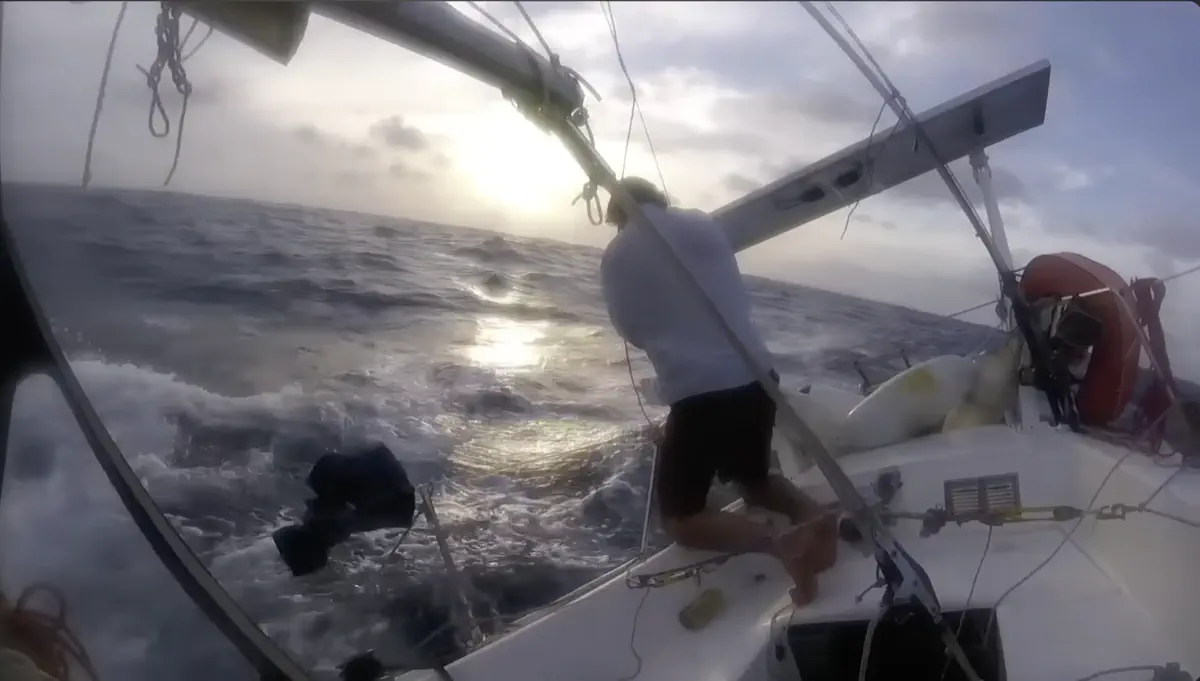
Defiant sailed up from the Caribbean to the lower Chesapeake Bay only two years before she came into my possession, which gave me a false sense of seaworthiness. Most of her house electrical, her freshwater plumbing and refrigeration were non-functioning. No HVAC or internet either, obviously. But the “big things” - the standing rigging, the sails, the engine - were presumably solid. The influencer voices screamed “go now! The broken stuff doesn’t matter!” and it was easy to write off all the missing pieces as unnecessary remnants of a former life (some of which were); I expected to be underway in a few weeks. At the same time, I needed to account for how living aboard would fit into my “remote work life” - and for that I turned to a CEO and full-time live aboard cruiser I had worked with. He never missed a meeting, always seemed professional and put together on calls, and if you didn’t know the beach behind him was real you’d think he was in a normal home office with a wishful background animation. It was just as easy to tally up my Starlink and Peplink router, the shower I would eventually fix and inverter I would install, and again expect to be underway in a few weeks. But herein lies the rub: fancy-camping influencers don’t need to be focused while they review software, or be polished and put together for a meeting. Floating condo owners don’t need to worry about running out of power for the Starlink, or the 30-year-old marine toilet breaking (again). Each system depends not only on the things it needs, but on the lack of other requirements that it cannot support. When both worlds are combined, the whole thing falls apart.
Refitters (that third group) are typically somewhere in-between the two types of “boat life”. They have older boats that are more restored than not, with modern & upgraded systems that feel close to floating condo standards. You can take a shower and flush the toilet, just not both at once. There are a couple trivial leaks that get catch buckets during torrential downpours, but there are no rotting bulkheads. This is where I find myself and Defiant fit best - not squatting in a tiny house and not in a floating penthouse, but in a solid home I’ve restored into something nice and inviting. What I failed to register early on is that every refitter’s story begins with “well we were on the hard for X years” with X ranging from 3 to 10 in most cases. Not accounting for that initial investment was a pretty significant error, and has been the source of much pain in the last year.
So would I call this a total fail? Not exactly. Defiant will be underway shortly, and she may see the whole of the US Eastern coastline this year. But the process was certainly not what I had planned for and I have had a lot of false starts. I think that warrants at least a temporary fail tag.
…And The Grand Total
A 4 to 3 success/fail ratio is not bad, considering I went into this thing with no idea what I was doing. These aren’t equally weighted items, either - something like financial health is far more important than my immediate success at world traveling. A lot can change in a few weeks, and if I revisit this at the end of the summer I might find it looks more like 6/1 or even 7/0.
So maybe I am not out of my mind, and maybe this is working.
“What in the fuck am I doing?”
~ me
Well at least for the moment, I’m winning slightly more than I’m losing 😎