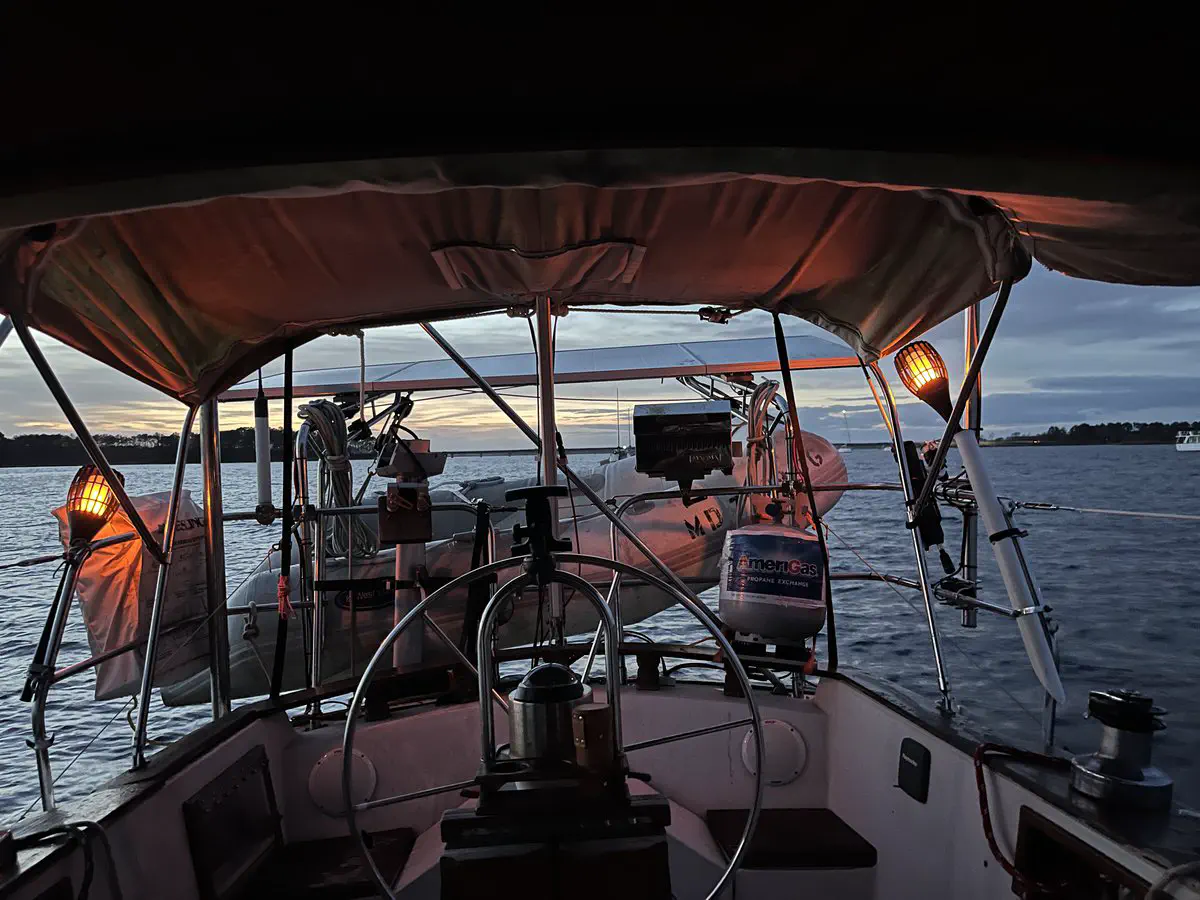
The ICW
Sometimes things happen fast. August took Bash and I up the bay to St. Michaels, where Defiant lost helm control (in the middle of the town entrance, no less). Limped into Annapolis on auto helm, then September to repair the steering, go over the engine, and finally re-glaze the butterfly lights so they stop leaking.
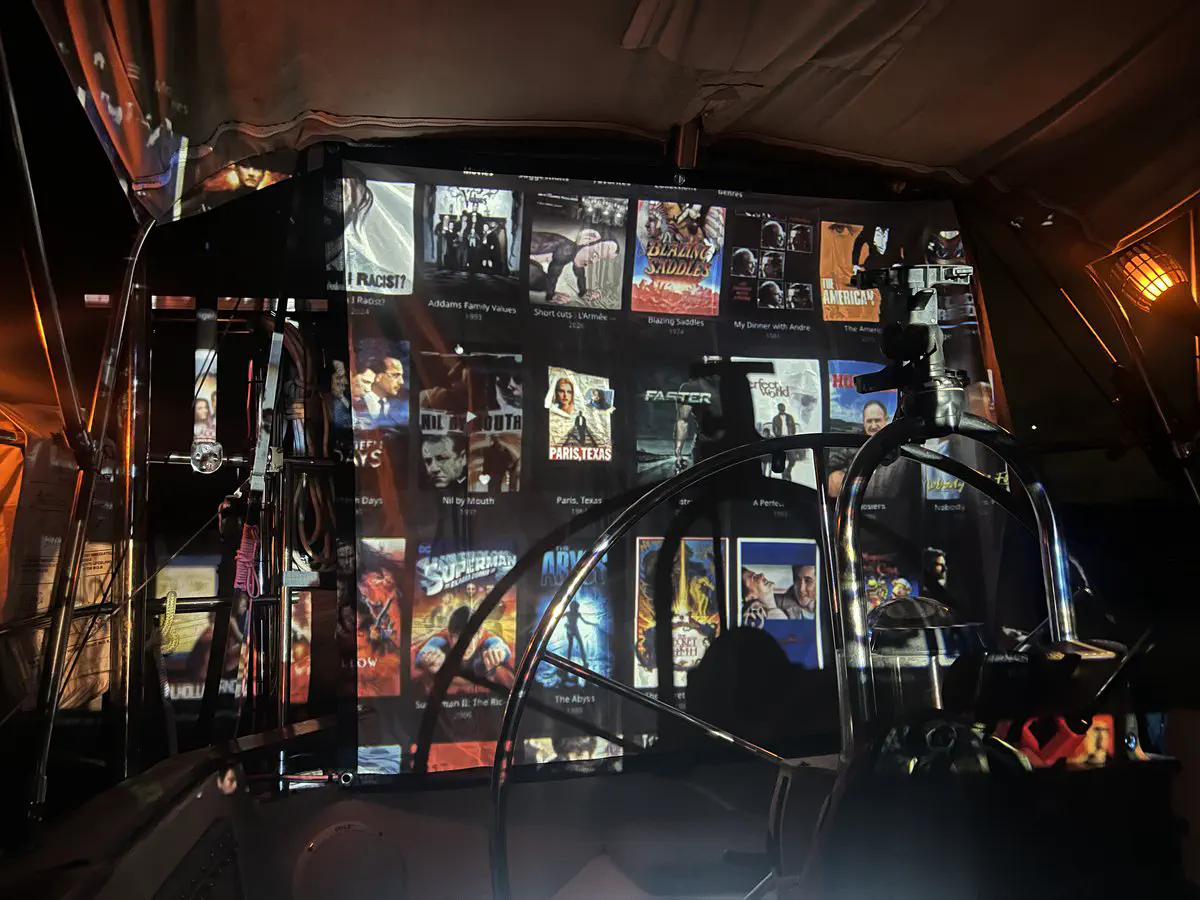
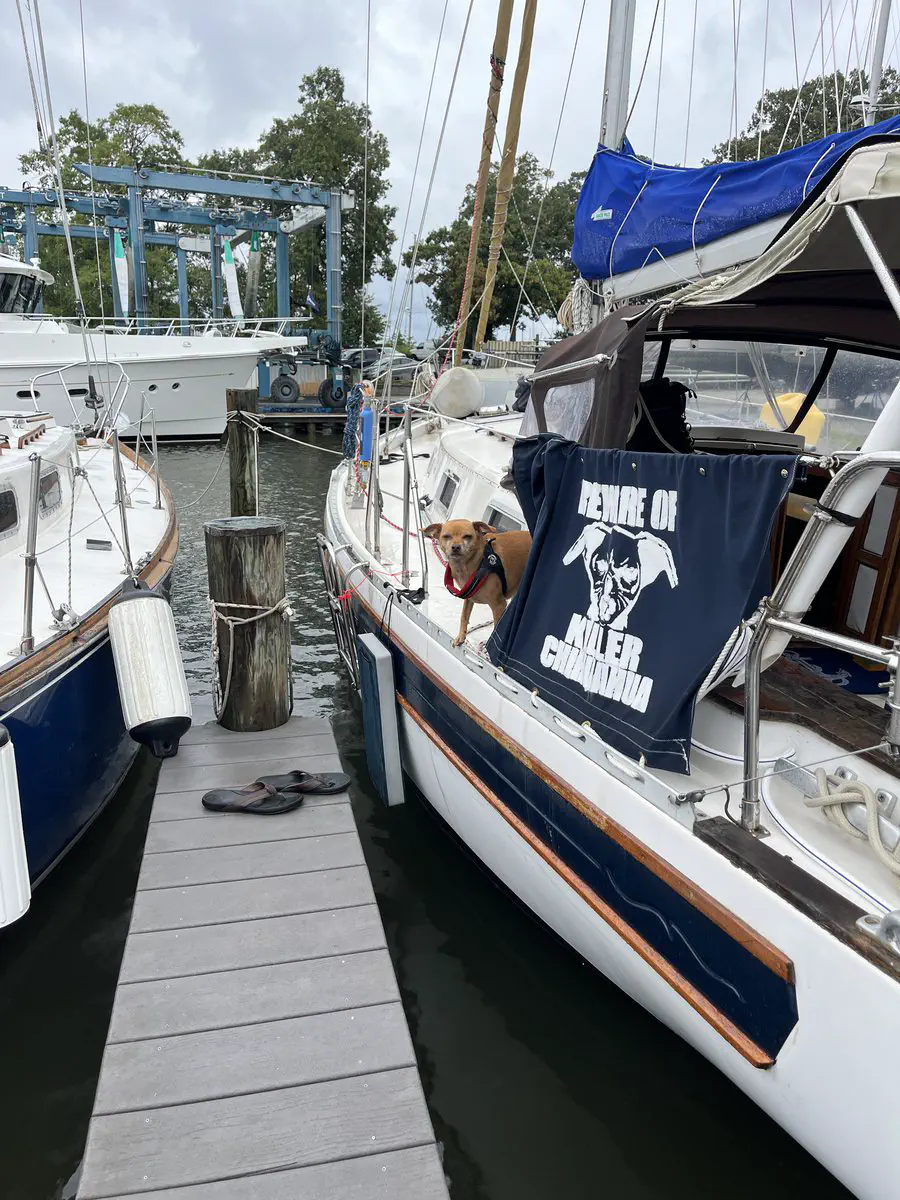
October brought the Annapolis boat show, and immediately after… our voyage south began.
Into the Meat Grinder
For the first week the bay was brutal. A small craft advisory brought North winds between 20-30kt all week - plenty of sailboat rocket fuel headed in the right direction, but wind at odds with the sea that made for short, violent waves. The sea pounded Defiant between a beam and broad reach, rolling her and tossing the cabin like a kid shaking Christmas presents to figure out what’s inside. There was no way I could work at the laptop underway, and the exhausting conditions made it a fight to squeeze thirty miles out of each day.
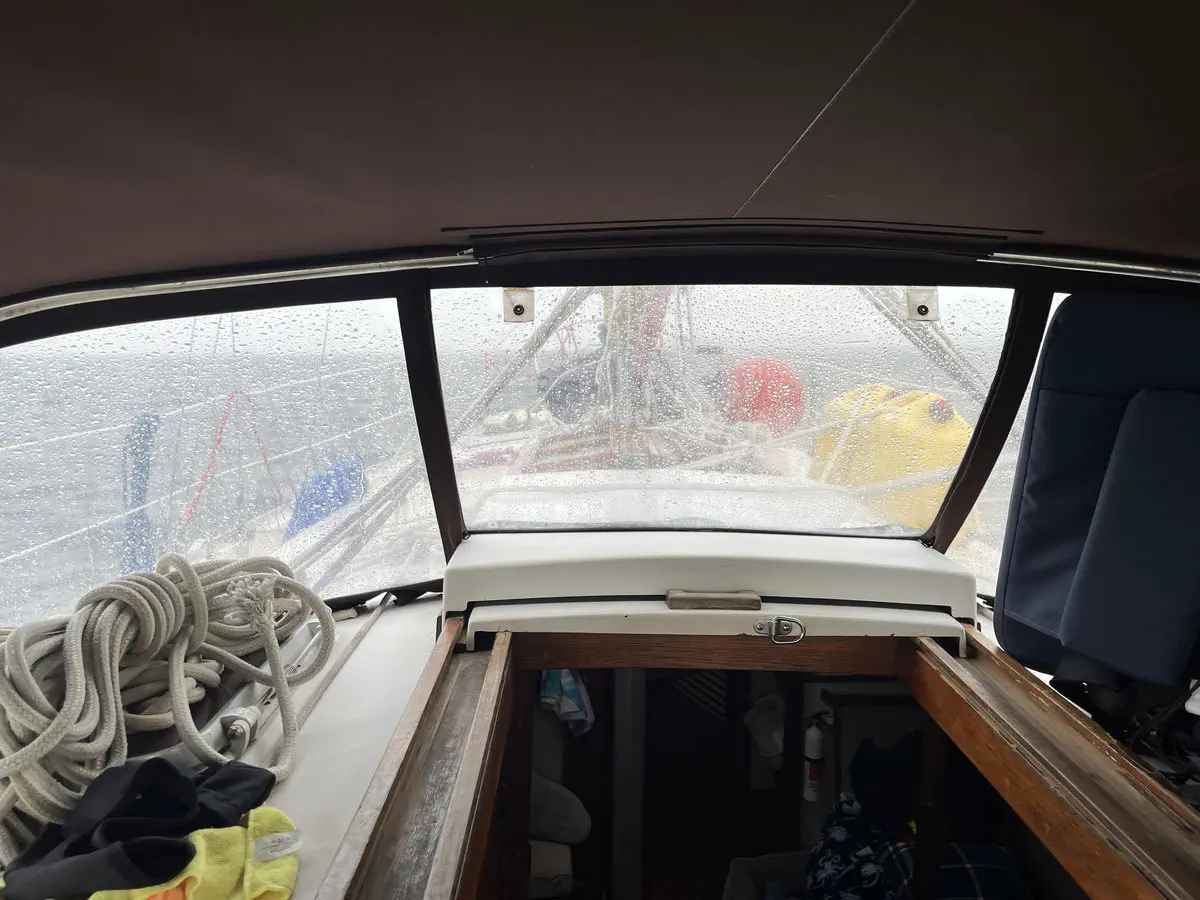
Two years ago I started this same trip down the bay, and I ran into the same “witch of November” - the pounding North winds and grinding seas as the Earth rearranges the atmosphere in preparation for winter. The same trip in 2024 was defined by terror and adrenaline. Everything in that trip felt clumsy and numb. Adjustments that should have been smooth and linear came out rigid, binary. This time around I certainly felt discomfort and some trepidation, but my decisions now are calculations instead of panic reactions. The heavy waves on the beam and the overpowered canvas were problems to be solved - adjust my heading, dump some mainsail, load up the headsails instead. The jammed furler, chart plotter glitch, stuck anchor snubber, leaky toilet supply line - things not working as expected have become part of the daily rhythm. The week in the meat grinder was some of the best sailing of my life - which is not a lot of sailing in the grand scheme of things, but no longer trivial.
As an aside, I fear that sucking at things is something of a lost art - which is a shame, because the process of evolving from sucky to not-as-sucky is one of the better parts of the human condition. I meet more people that either only do things they already know how to do really well (usually stuff they started doing as a kid), or stick to a sanitized, tourism-friendly version of new things. I am not an expert sailor yet by any measure, but each day I whittle away another 8-10 of my 10,000 hours.
Windmill Point
I made port at Windmill with an intention to refuel, make some repairs, and run the first vehicle hop; my reception was as warm and welcome as ever. Friends were waiting at the dock with bourbon and hugs - what more could Bash and I ask for? While in port I added a cleat under the desk so I don’t have to stow the chair in the tub. I fixed the diesel heater, again, and descaled the shower heater pump so it would actually heat, again. I had the hull/prop cleaned and a new zinc installed - the diver pulled whole oysters off my prop and scraped a ton of growth off the hull; Annapolis must have some very aggressive marine life. I couldn’t wait to get back underway and see what my nice clean hull and prop would do to my speed (turns out I wouldn’t be disappointed).
Near the end of my first vehicle relay to Annapolis, the clutch on my motorcycle gave out. I was able to limp to the bike to where I had parked the truck, load up, and drive back down to southern VA; but now I had to either stop and fix the bike or find somewhere along the ICW. Stopping was not a great option, winter is coming.
I decided on a motorcycle dealership in New Bern, NC - a cute little winter haven town for boaters with many, many fiberglass bears. Bash and I trucked down the 10 hour round-trip to drop off the bike on Halloween, then fueled up Defiant and got underway before sunrise the next day.
Norfolk
The sail from Fleets Bay to Norfolk was, in a word, perfect. Defiant felt two tons lighter, with the spotless hull she gained more than a knot at the same wind speeds. we made 6.5kt from port to anchor on two tacks - both beam reaches with glass-smooth water. My stop at Windmill had added a buffer from the boat show crowd and so for most of the passage I was completely alone. It was magnificent - the kind of open water sailing that cruisers dream of.
While underway I washed dishes and made pizza. I read most of an Ian Fleming novel. I wired temporary power to the radar (I’d had no use for it until then, but knew it would be needed on the first day of the ICW proper). All the way I’d set a timer every 20 minutes to pop my head up and look around, make sure I was still all alone, and then go about my business. The only sounds were the gurgling of the water along the walls of the cabin. This was good, good sailing.
Bridge & Tunnel Day
Norfolk is technically mile marker zero of the ICW proper, and the first day is all things scary and challenging - commercial traffic in tight channels, sometimes barely wide enough for one boat each way. 14 Bridges (!) and a lock, and then miles of squirrelly, twisted tracks to get to Coinjock marina.
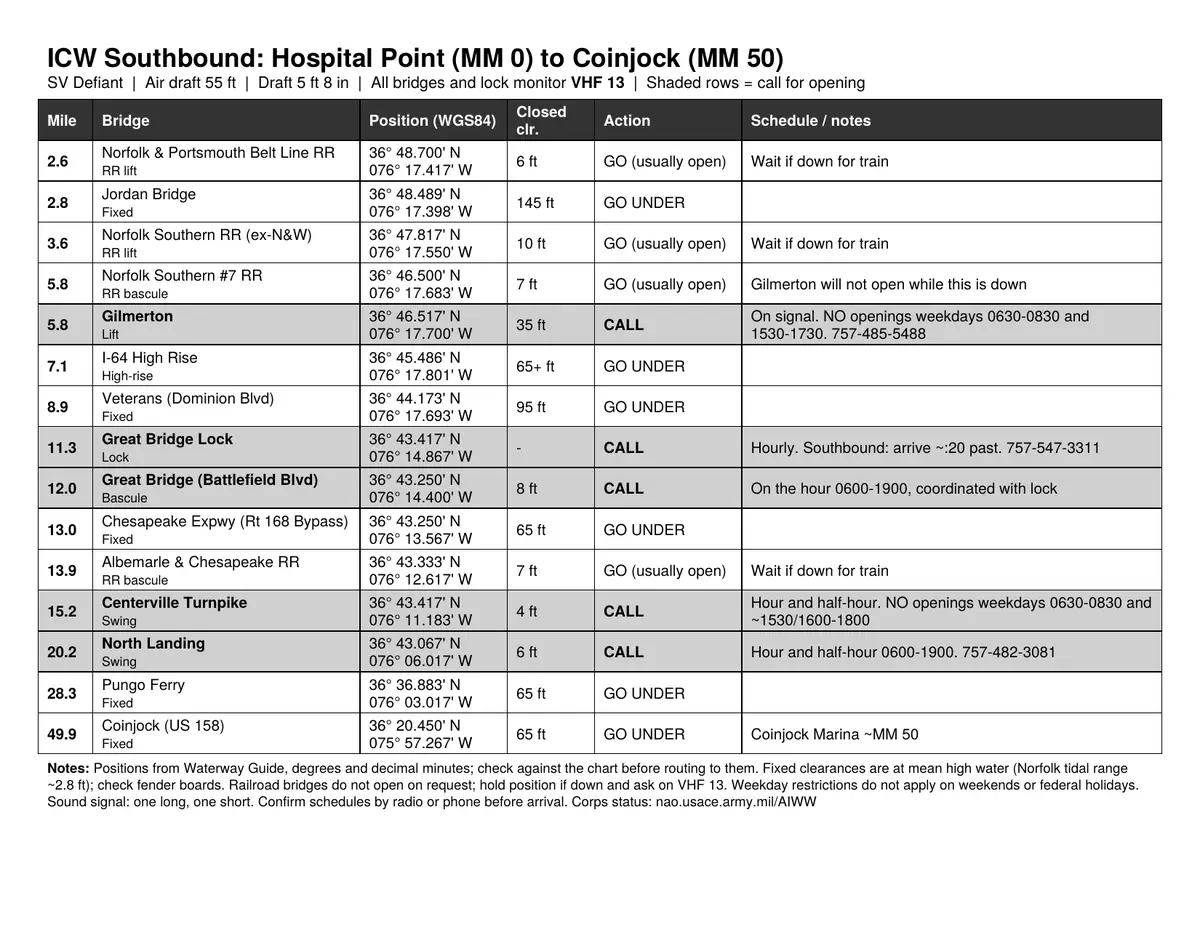
There’s a few things going on with this day that I find people don’t really explain well.
There are no ditch points along the route. Once you start down this section of the ICW, it is a lot like getting on I95 - you can’t just pull over on the side and drop anchor. What little I’ve seen past Coinjock is much more forgiving, but this part is a commitment.
Bridge Etiquette.
Most bridges want a head’s up 1 mile before you arrive, regardless if they are on demand (“signal”) or on a schedule. But if they are on a schedule, make sure you say the next scheduled opening in your hail (i.e. “Centerville Bridge, Centerville Bridge, this is Southbound Sailing Vessel Defiant, I am at marker X about 1 mile from you, requesting your 9am opening at that time”) or they will think you are asking for an on-demand open and will get notably pissed at you.
Tell the bridge operator when you get through and say thank you for the opening. That way they can start closing up, an it makes them nicer.
Some bridges want your USCG registration number, have it ready. Everyone else has to wait while you find the number and you can hear all the other pissed off boats that just want the damn bridge open.
Note Every Bridge, Even The Fixed Ones. There are some fixed bridges that we just sailed under, but it’s hard to know which ones are which until you get up close. There is no eyeballing bridges; 145ft and 55ft look pretty much the same until you are about to smash into them. Smashing into a bridge might only destroy the mast or it might sink the boat - either way, it is a bad thing. That list above let me check off each bridge, even the fixed ones, so I knew which was coming next.
The Coordination Is Exhausting. Sailboats don’t move well in stop-and-go traffic, which is most of this leg: stop-and-go approaches in a pack of boats waiting for bridges to open, stop-and-go departures after each bridge while the pack breaks up. The natural inclination is to take things slow, hang back, but you can’t - you need every tenth of a knot to make the next bridge opening. It felt like one day-long exercise in tight-quarters marina docking, and by the time we reached Coinjock I was completely fried.
Coinjock
The first real “ICW town” is Coinjock marina - a tiny little set of side-up docks along the channel, a ship’s store, and a restaurant. Everyone stops here, because it is the only place too stop. Boats were rafted two up (first fill the dock with boats, then tie more boats to those boats). I had the famous Coinjock prime rib - and I mean famous. This steak is so popular you need to call ahead and reserve your cut of meat; since that day, when I tell someone I docked at Coinjock, their first question has consistently been some version of “did you get the prime rib?!?” The prime rib is $44 for a 16oz cut, served au jus. My guess is the reservations are so they know how many steaks to pick up at Old Country Buffet for the evening. To be fair, prime rib is probably my least favorite cut of steak - but this was an abundance of sinew with an equal absence of marbling. But at least Bash enjoyed it.
* To Be Fair, multiple people have since told me that the Coinjock prime rib this season has been extremely disappointing, so maybe it was once something amazing. Regardless, it isn’t that now.
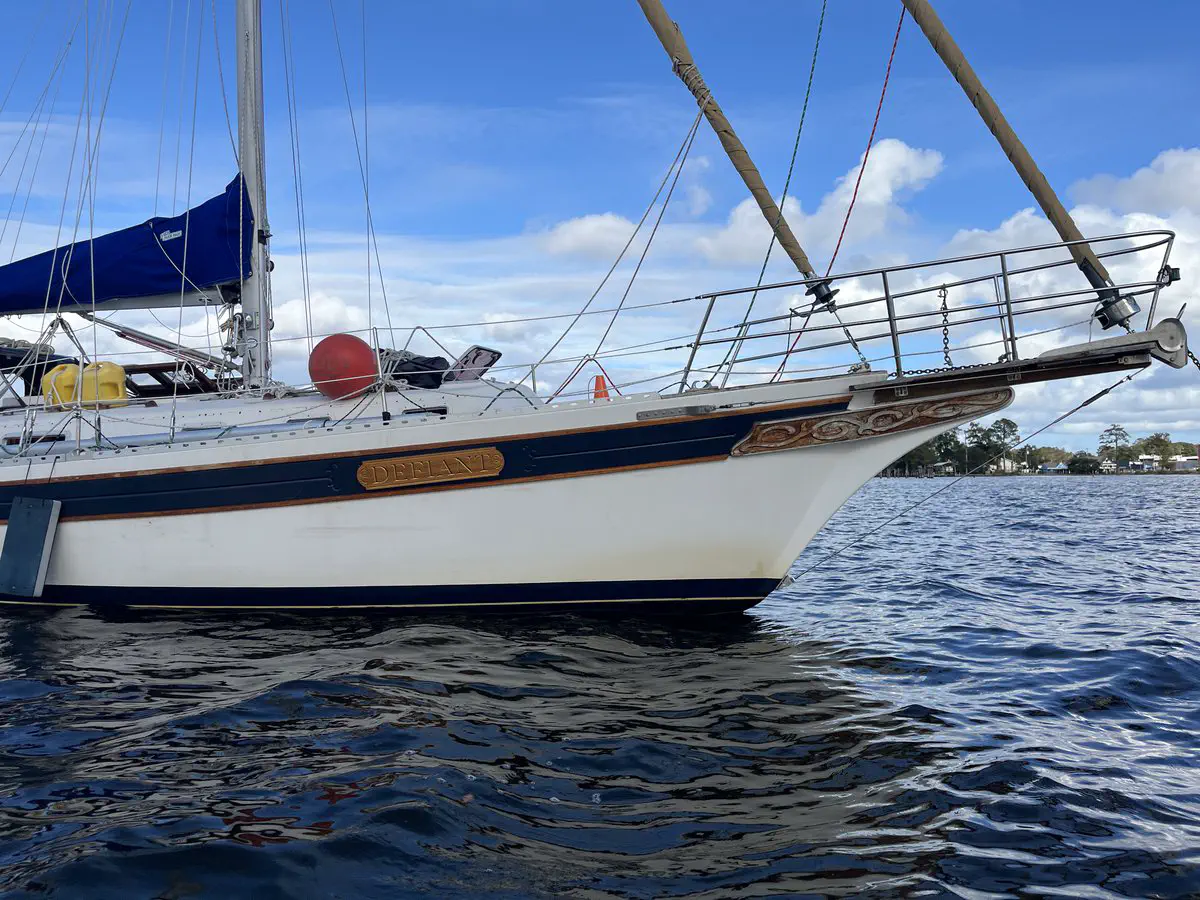
I think the magic of the Coinjock steak is not the meat, but he meaning. Humans derive value from hardship - It is one of the hardest things about living aboard to articulate, but one of the most significant. Getting to Coinjock is hard and that slab of meat is the trophy, so regardless of how it actually tastes, it tastes like victory. I get that.
North Carolina
The Albamarie sound is one of those bodies of water that can be trivial or murderous, depending on wind and wave. Nature decided to offer up the former, and both the crossing and then all the way down the Alligator river was equally uneventful. At anchor off the Alligator river, the night sky was finally dizzying with stars and the water was still, and silent.
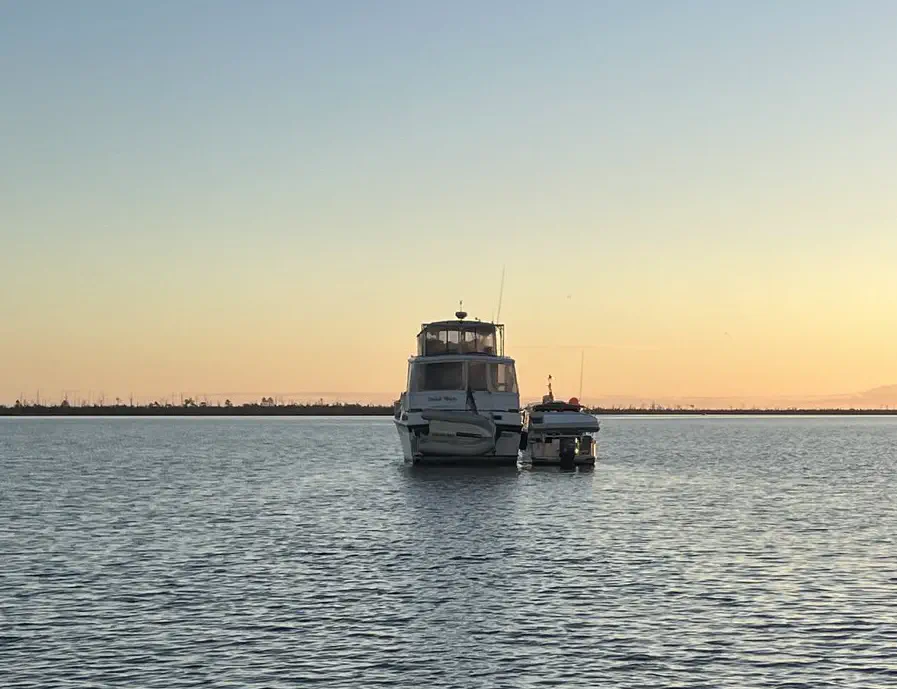
The evening was notably warmer than even two days earlier at Norfolk - I skipped the diesel heater in the morning as we made way to Belhaven.
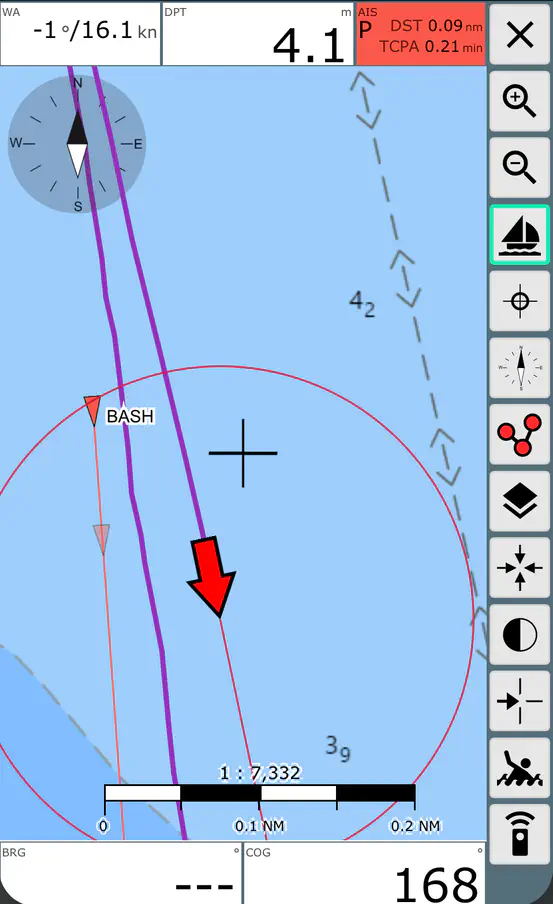
The fat western tail of the Alligator river opened up to a wide body of water deep enough to sail, and the North wind picked up quickly to 15kt on our beam.
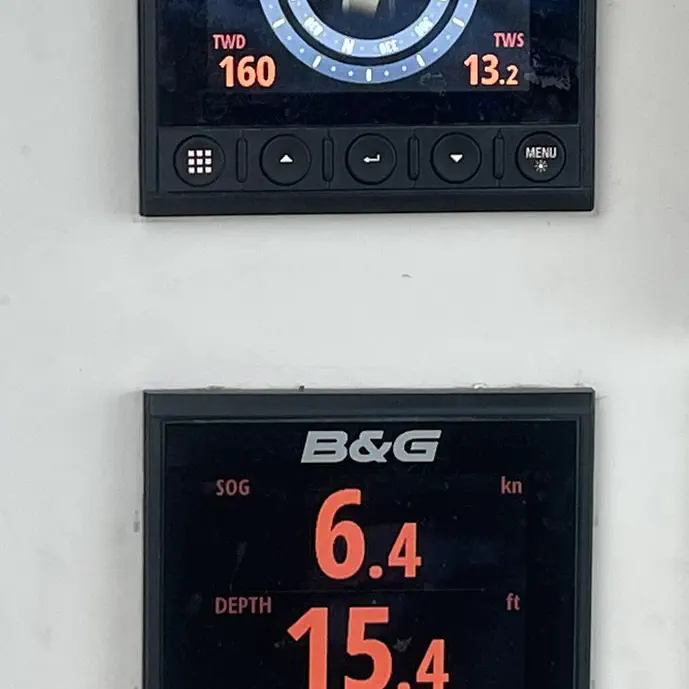
I was super happy to be sailing again, excellent sailing in fact, at nearly hull speed. Sadly our course required a hard turn that put the wind directly ahead, and Defiant cannot go due windward with a headsail up under any conditions. I settled her in irons and began to furl the jib, when it jammed up hard. The wind picked up, and held at 20kt.
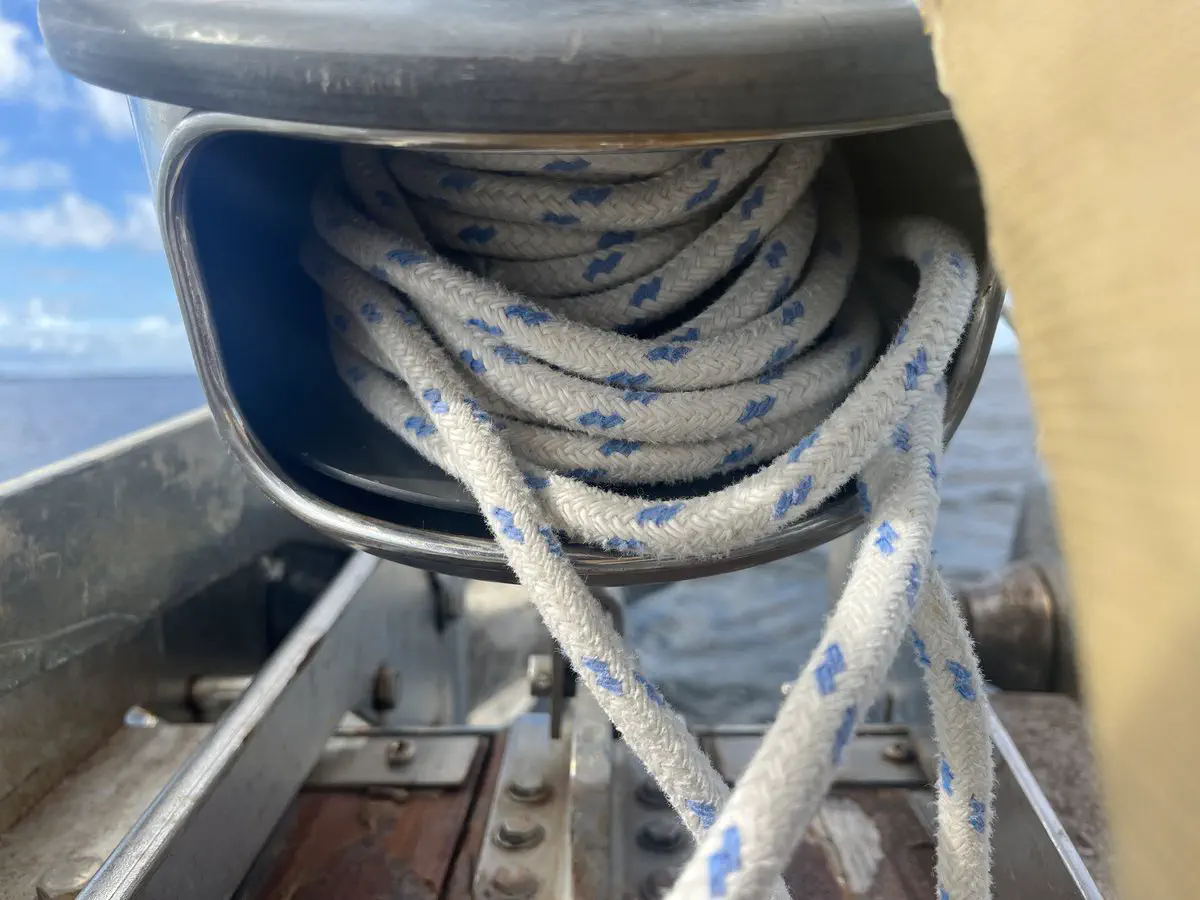
And so I found myself on my back under the sail, laying across the bowsprit, feeding slack carefully into the furler and trying to untangle the stacked overrides without success. The jib thrashed violently over my head, the boat pitched violently in response. I forced the furler out by cranking the drum backwards, releasing enough tension to drag down the jib halyard and dump the sail on the deck.
At the calm of anchor I untangled the mess, hoisted my sail, and was ready the next morning for another day of excellent sailing. And it was, in fact, another really wonderful day underway. It rained a bit, and the gloom and gray sky made 20kt feel like 40kt, but Defiant skipped along, pinching a very close haul that was uncharacteristically pointed for her. And then the jib halyard snapped.
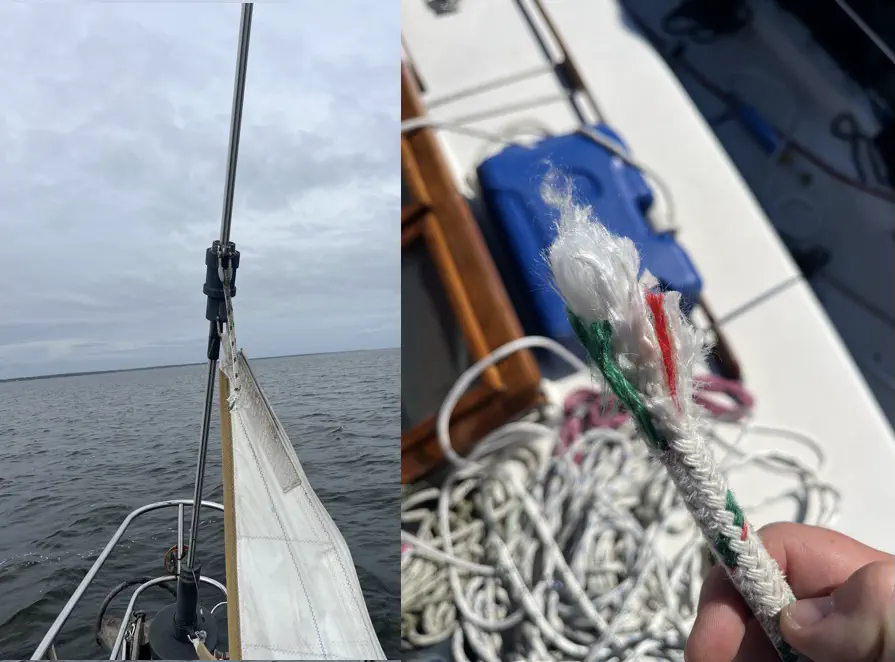
The boat flung back to windward as the sail dumped into the water, the way a motorcycle dives forward when you roll off the throttle hard. I scrambled to the bow and began to drag the jib out of the water. I had to basically lay on the sail to fight the wind from ballooning it out wildly, folding the Dacron over and tying it off with docking lines, anchor snubber - whatever was at hand. Even with just the main, and with the boat spasming off speed as the headsail exploded over the foredeck, I was still making a decent 5kt toward New Bern. When my adrenaline finally leveled off and I was able to clear away the tangled jib sheets, I let the little staysail deploy - it shot out like a shark fin in all that pressure, and we made a surprisingly comfortable 6kt all the way into port.
Sailing blogs are full of these stories, and I know they are intolerably dull and repetitive to read; what fails to come through is how, in these moments, it becomes normal to think “maybe this is how I die.” That is not a bad thing - on the contrary: I’ve come to believe that a circadian rhythm exists between mortal adversity and resolution, a rhythm that is no less essential to human life than breathing. There is no space for depression or anxiety in a meat grinder. Maybe that’s by design. Facing the possibility of losing life every day goes a long way towards appreciating it.
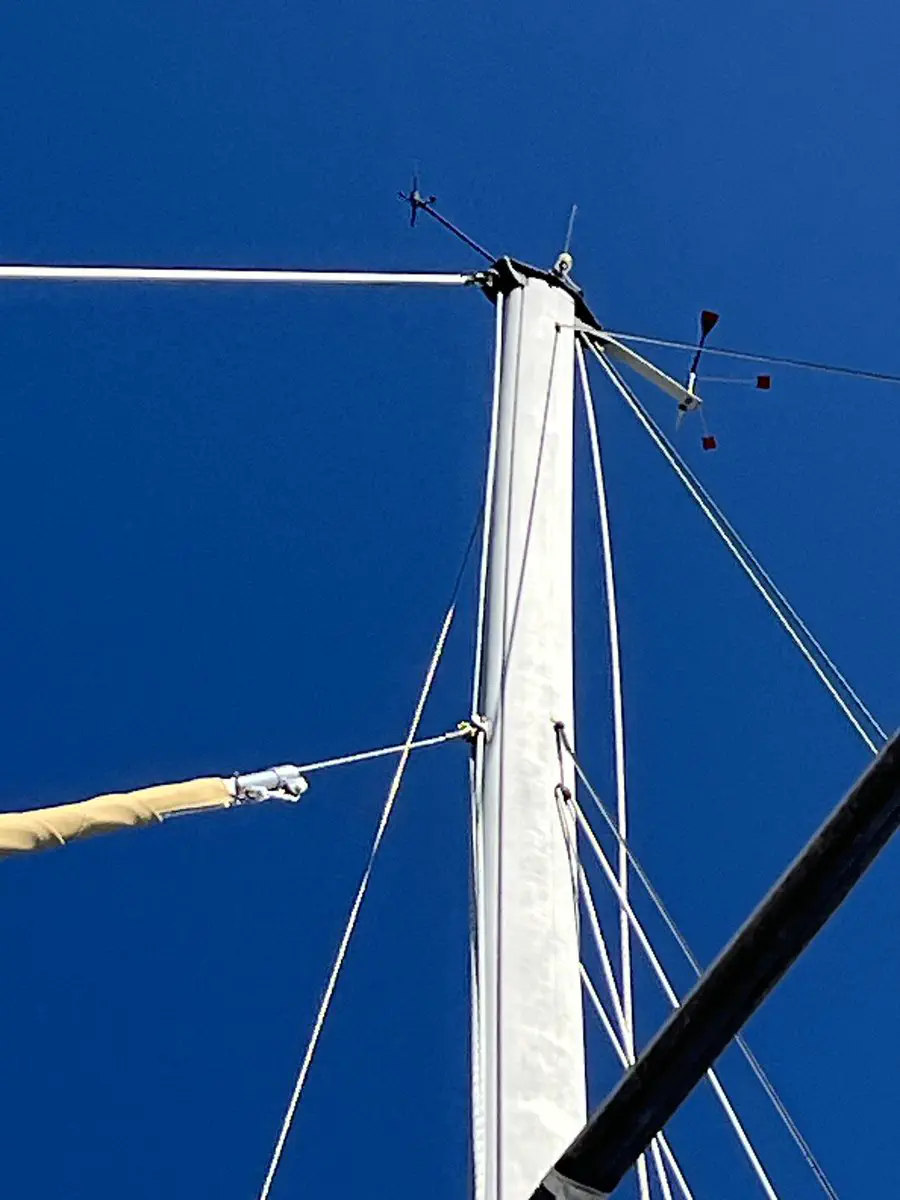
Later on, I’d figure out that when I brought the jib back up I made the halyard too tight, locking up the bearings in the furler head and causing the halyard to twist around the forestay (instead of spinning freely as I furled the headsail as intended). This twist in the line was so tight that it cut through the halyard. With any luck that’s all it did; but the ordeal could have damaged the foil or even weakened the forestay, I won’t know until I get eyes up there to look first-hand. These are painful and expensive lessons to learn, but they are the lessons that make compound over time to make us experts.
Defiant limped into the New Bern Grand Marina on main and staysail. New Bern is a fun, artsy little town, like a New Hope or New Paltz (why is everything New?). Like most places south of Virginia, things slow down a bit. Slower, and sweeter. The food is just…
So. Fucking. Sweet.
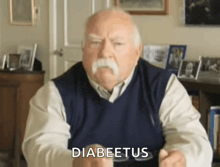
In the Carolinas they put sugar on their sugar, and then put icing on that.
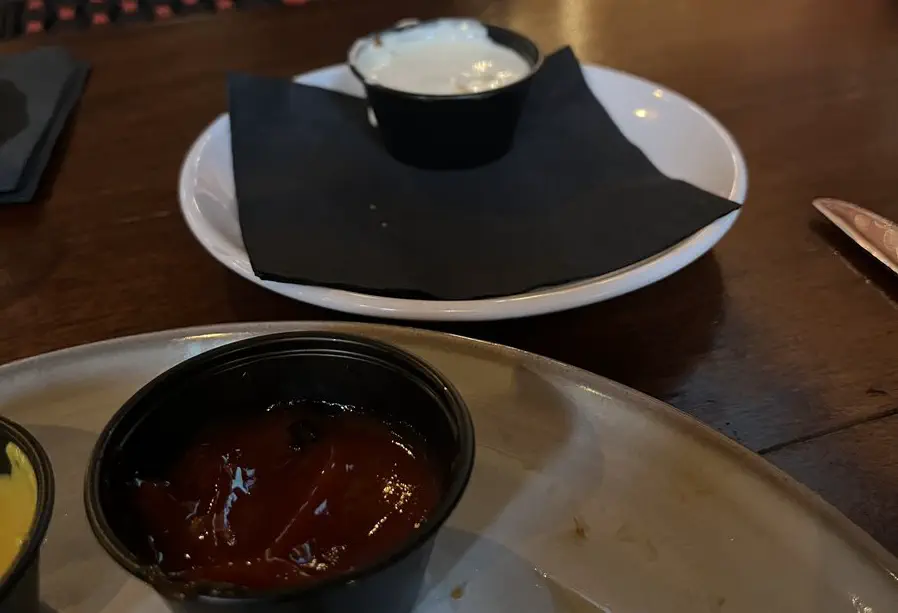
At the dock in New Bern, I had a few days to breathe before the rest of life caught up.
Then one night, Bash started screaming. The good thing about not having a regular relationship with a doctor or veterinarian is that you are always starting from scratch. 30 miles outside a small NC town, at 11pm on a Tuesday, you take whatever you can get - in this case an all-night animal hospital.
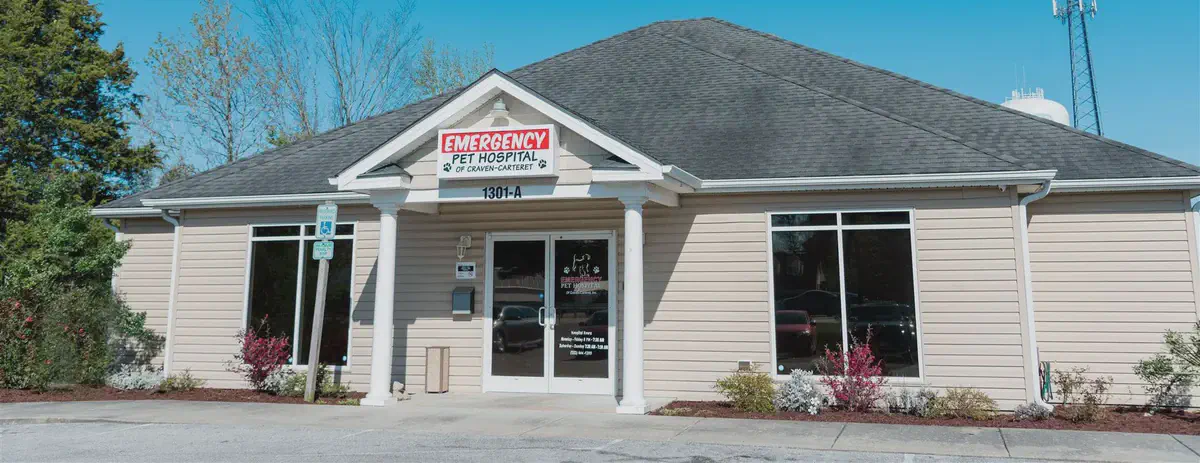
Lucky for us, what Bash got was excellent care from remarkably competent veterinary staff - and unlike almost every vet he’s ever seen, they weren’t afraid of him. No trazodone or gabapentin, no Hannibal Lecter mask, just an unfazed vet tech holding the little chainsaw by the scruff while he exhausted himself snarling as she went about her business. $1400 and several hours later, Bash was home with pills for what turned out to be a rather benign stomach virus.
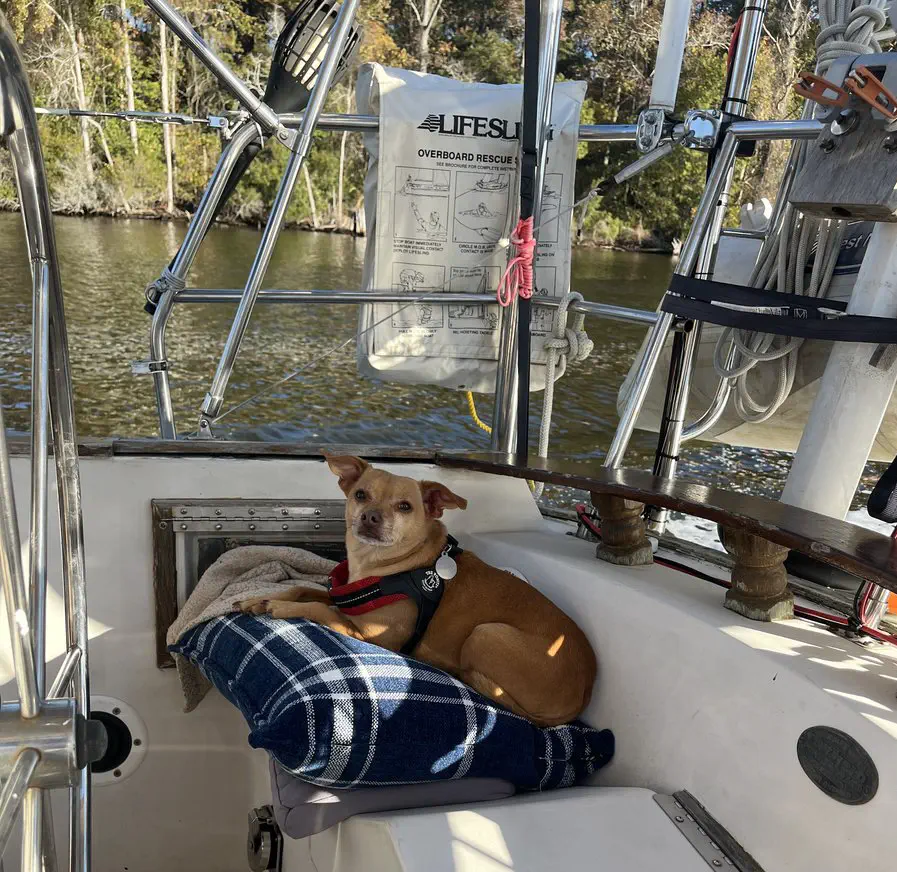
Back to the real world: a one-way rental car up to Virginia got Bash and I to our truck; then a drive up to Philly, a train to New York for meetings, a train back down to Philly where I collected Bash and the truck, then a drive back up to New York (Hudson Valley this time) for an early thanksgiving with the family, and finally a cannonball run back down to New Bern.
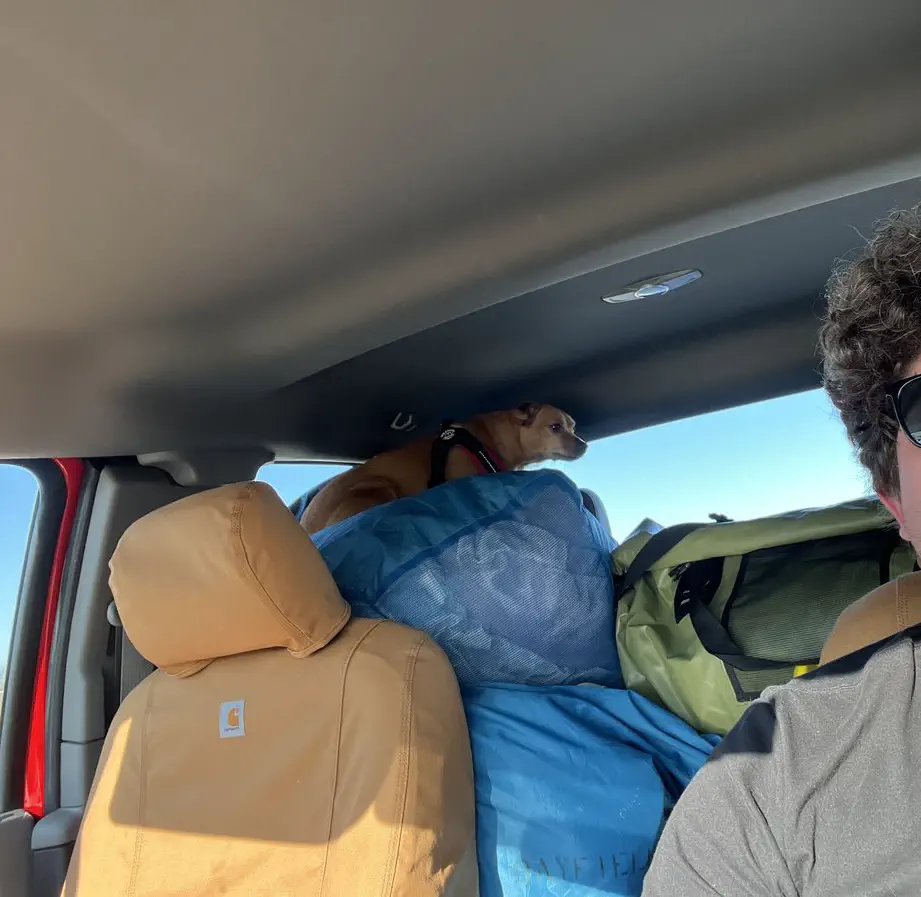
Had it not been for Bash, this could all have been an Uber and a couple of quick flights; dogs make everything harder. But he is a decent travel companion, and he puts up with a lot of shit - so I guess we’re even.
What Comes Next
A few (hopefully) quick fixes, some new tech and kit bits (more on that to come), and then we’re off to Charleston SC.